Maybe I should call it "Saturday Shocking Story" since "Friday Fun Fact" can never seem to come out of me on Friday!
But this one is a gem, reported in
National Geographic News last week and it is 100% true, I swear.

Seems like songbird couples and human couples are, well, birds of a feather. Take, for example, the Peruvian warbling antbird (Really? They couldn't come up with a catchier name for it than that? Ah, ornithologists, I expected better!), seen on the right. Monogamy is very rare in the animal kingdom, but it appears these birds do try (Well, at least the girls do. Sound familiar, ladies?). When a male and female (Mr. and Mrs. Antbird if you please) pair is approached by another antbird couple, they sing a harmonic and coordinated territorial song, proclaiming their union and their stake on their choice piece of property.
However, if a single female (young Miss Antbird) approaches, the Mr. continues his melodious song to her, while the Mrs. changes her song to a loud, discordant signal that covers up her mate's attempts to flirt with the would-be homewrecker!
I think, translated into English, it would play out something like this:
Miss: "Hey there, fella, how YOU doin?"
Mr: "Hey baby, you are one fine..."
Mrs: "OH NO YOU DON'T! MISS THANG, YOU BETTA GET YOUR SKANKY LITTLE FEATHERS OUTTA THIS JOINT!"
Some conversations are just universal...
So who knows what the #1 pollutant in the US is?
I'll give you a hint:


Figured it out yet?
Yep, it's sediment. Dirt. Earth. Soil. Mud. Whatever you want to call it, it is carried by runoff and pulled from banks by erosion and our streams are FULL of it.
But, you say, dirt is part of nature, that's no pollutant! Well, you know the saying, "all things in moderation?" Well, that applies to ecology too.
Because of a variety of factors that have to do with channel shape, current speed, and stream path, a running body of water has a limit to the amount of sediment it can carry and move without becoming overloaded. Each stream, therefore, does have the ability to clear sediment out by carrying it and depositing it either along the bottom, on a bank or bar, or at its mouth. Likewise, the animals that live in the stream, mussels, fish, bugs, etc, each have their own tolerance to limited amounts of sediment for short periods of time.
It's when those tolerances are exceeded that this sediment becomes, in fact, a pollutant. When streams are frequently running muddy, when the bottom is nothing more than shifting mud or unconsolidated sand, when the banks are cut by erosion, dumping their clay into the water itself, problems abound.
Sediment smothers mussels so they cannot feed or breathe. Fish gills get clogged so the fish can no longer absorb oxygen. Many fish also rely on their excellent eyesight to find food; in muddy water, they are hungry and helpless. By blocking light, sediment also suffocates plant life beneath the surface that may be vital to fish and insect life. When all of this happens, it is an ecosystem in chaos and it also means the water supply is in trouble.
I mentioned that this sediment can come from bank erosion -- this erosion is often caused by a stream trying to channel more water than it is built for. This is usually due to our compulsion to pave and cover everything we can. Every square inch of ground we pave or harden with a rooftop is one less square inch that can absorb water. Thus, every drop of water that hits there will become runoff and we all have seen what a powerful force runoff can be.
In developed areas, most of the time, runoff is channeled into storm drains. Which usually then lead directly to a stream or other body of water, they ARE NOT filtered or cleaned in any way. This water also usually enters the stream at a single point -- it's like turning a fire hose on and blasting sediment right off of the banks, that's what kind of power this water has, especially during rain events. I remind you again, streams are your water supply, so anything you dump down that storm drain, you are effectively pouring into your glass of water. Sediment often enters the water supply here, running off from construction sites and yards. Most counties do have regulations about sediment control on construction sites, but the problem is that, even if these regulations are enforced (the enforcers are often far too few), the conventional technologies they require (silt fences, stormwater ponds) are very ineffective.
If you see a stream choked with sediment, especially if it is not raining, you can and should notify your county and notify your state water quality agency. A simple Google search can direct you right to them. Notice silt fences around a construction site are collapsed or leaking mud everywhere? Call and report it to your county, contractors and developers ARE required by law to maintain those. You have a right to clean water, wanderers, and it is up to each of us to stand up for that!
Well, I have discovered that one of my friends from high school has a fantastic blog that you should definitely check out, dear wanderers!
Green Design CollectiveThe graphic on the latest post is worth the look alone, LOL! And it looks like we have some of the same things on our minds, including water and energy conservation. Well-written and well-researched, her blog is sure to provide a steady stream (haha, "stream", get it! Ohhhhh, I crack myself up) of useful information to help you save money by reducing resource use and give yourself plenty of warm fuzzies by taking real steps to lower impact living.
I command thee: Go! Read! Enjoy! And I shall sit here and ponder what is on my mind next.
I love spring and it is here and my pores are sucking in all that Vitamin D as fast as they are able. Goodbye drear winter days and grey landscape! The daffodills and the crocuses are up. My forsythia died, but my phlox, wax myrtle, magnolia, and verbena are coming back to live and already blooming! My salvia is growing new leaves and even the boxwoods in front of the house, whom I swear grow slower than molasses in January, are shooting out new, fresh green. Go bury your nose in a blossom and breathe that sweet spring air (don't snort any bugs though, they don't like it)! It always seems a season of celebration to me -- flora and fauna alike seem full of energy and a passion and joy for existence that gets lost over the winter months. As the sun grows stronger every day, it reminds me that even though things may look dark and dead, they are only hiding their resources deep within, just waiting for the chance to flourish when the time is right.

In the vein of the "biofuels" theme, let's talk briefly about palm oil. This goop is one of the primary ingredients of "biodiesel." Well, a perfect place to grow palm plantations is Indonesia, especially Borneo (home of the much-loved orangutan) -- they've got 15 million acres of previously incredibly diverse rainforest that are now under cultivation as palm monocultures. And a monoculture has virtually no value as wildlife habitat, carbon sink, food source, and is very vulnerable to disease -- when these large areas consisting of a single species take over, you can kiss the rest of the system goodbye. In addition, massive fires set annually to clear land for palm oil plantations have release HUGE amounts of carbon stored in the area's deep (up to 60 feet) peat soils.
From 1985 to 2005, a third of Borneo's rainforests, which contain a staggering 15,000 plant species and could be considered the most biodiverse in the world, have been mowed down for oil extraction, palm plantations, and mining. Large timber and resource extraction companies rape and pillage the landscape, stealing resources from hungry people knowing that, even if they get caught, there will be no one to hold them accountable or mete out punishment.
You can, at the least, reduce the demand for this type of product with your own use choices. Don't choose "biodiesel" for your truck and tell this industry that you are not willing to accept their short-sighted greed. Want an alternative to regular diesel fuel? Opt for a retrofit that will allow your engine to burn used vegetable oil, a recycled product that has virtually no additional impact between the restaurant fryer and your truck.
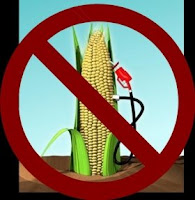
Ethanol -- one of the great marketing scams pulled on society. Supposedly the great savior to replace fossil fuels, corn-based ethanol was touted as the "green" alternative. Once again, good intentions pushing fast and hard into the market, unwilling to consider the big picture and the long term paved the road to hell for us. Just a few facts to consider:
(1) To produce a gallon of ethanol, it takes about 70% MORE energy than you actually get from burning the ethanol itself. So the overall process = net energy loss. This particular piece of genius *insert dripping sarcasm here* continues to baffle me daily.
(2) To grow and harvest an acre of corn to produce ethanol takes about 140 gallons of diesel.
(3) Corn itself is an incredibly water-hogging and destructive crop to grow. Producing it erodes soil about 12 times faster than the soil can regenerate and irrigating it drains groundwater about 25% faster than that water can refill and recharge.
Not to mention using a food source to power vehicles is just plain stupid. The acreage it takes to grow enough corn to power one average car for a year (11 acres) can feed seven people. I'll let you do the math. And I won't even mention what happens to people both domestically and abroad, when you drive up the price of corn, not only as a primary food source, but as feed for livestock.
Suffice it to say, any vehicle labeled "FlexFuel" or powered by ethanol is about the most environmentally UNfriendly choice you can make and you should run, run in the other direction. An agricultural expert from Cornell University put it well:
"Abusing our precious croplands to grow corn for an energy-inefficient process that yields low-grade automobile fuels amounts to unsustainable subsidized food burning."Are there better options out there that CAN effectively replace fossil fuels? Maybe! More to come on this topic....

Sounds impossible, eh? You know how it goes -- your cell phone dies mid-sentence, the camera conks right as you take that once-in-a-lifetime shot or your mp3 player quits in the middle of your favourite song (DAMMIT!!). Next step, plug it in, sucking power from the ever-present grid, which costs you money and burns up resources. Right?
Right?
Well, my dear wanderers, we are FREE AT LAST! Ok, at least in those particular situations. We now have charger options whose power source is free!! and impact-less (aside from production of the actual unit of course).
Want really cheap and basic? Go for hand-produced crank power for your cellphone with the
Sidewinder.
Want a little (or a lot!) more power and control? Go for a portable
solar powered charger.
And my personal favourite, use your booty-shakin' powers to fire up your electronics with the
Dance Charge. Brings a whole new meaning to the "electric slide." Yes, do try to control your hilarity at my sheer pun brilliance...
 Seems like songbird couples and human couples are, well, birds of a feather. Take, for example, the Peruvian warbling antbird (Really? They couldn't come up with a catchier name for it than that? Ah, ornithologists, I expected better!), seen on the right. Monogamy is very rare in the animal kingdom, but it appears these birds do try (Well, at least the girls do. Sound familiar, ladies?). When a male and female (Mr. and Mrs. Antbird if you please) pair is approached by another antbird couple, they sing a harmonic and coordinated territorial song, proclaiming their union and their stake on their choice piece of property.


